Kansas City Pest Control for Pantry Pests: Why Indian Meal Moths, Weevils, and Beetles Show Up in Clean Kitchens

A homeowner opens a bag of flour purchased three weeks ago and finds small caterpillars crawling along the seams. A jar of birdseed in the garage hatches out a cloud of moths the next morning. A forgotten bag of pecans produces small reddish-brown beetles that have somehow reached the unopened oatmeal one shelf over. The assumption is almost always the same: the kitchen must be dirty, or something got in from outside. Neither is usually true. The insects were already in the food when it was purchased, and they came from the manufacturer. Kansas City pest control providers who handle stored product pest calls, including ZipZap Termite & Pest Control in Lawson, see this pattern constantly, and the fix is less about extermination than understanding how these species actually get into homes.
Where the Infestation Actually Starts
Pantry pests are stored product insects, a category of species that completes its life cycle inside grain, flour, nuts, dried fruit, pet food, and any processed food containing starch or oil. The life cycle begins at grain storage facilities, food processing plants, or warehouses, where adult insects lay eggs on or near raw product. Packaging and heat pasteurization kill most but not all of these eggs, and a small percentage travel with the product through distribution to the grocery store shelf and into the consumer’s home.
Once the product reaches a pantry, the eggs hatch on their own schedule. Larvae feed inside the food, mature, pupate, and emerge as adults. The adults then fly or crawl to nearby packaging and start new populations. By the time a homeowner notices activity, the infestation has usually spread to three or four adjacent products, because an adult female Indian meal moth can lay 100 to 400 eggs over her lifetime.
Nothing about clean countertops or sealed trash prevents this. The insects arrived inside the package.
Identifying the Main Species
Four species account for the large majority of pantry pest calls across the Kansas City metro.
Indian meal moth (Plodia interpunctella) is the most common. Adults are small moths, about 3/8 inch wingspan, with a two-tone wing pattern: the inner half coppery tan, the outer half reddish-brown. The larvae are pale cream to pinkish caterpillars, and they produce visible silk webbing in infested food. Webbing in a bag of flour, rice, or dry cereal is the clearest diagnostic sign.
Sawtoothed grain beetle (Oryzaephilus surinamensis) is a slender, dark brown beetle about 1/10 inch long with six distinctive tooth-like projections along each side of the thorax. Populations build quickly in flour, cereal, dried fruit, and pet food. Adults do not fly well and are often found walking along shelf edges.
Cigarette beetle (Lasioderma serricorne) is small, roughly 1/8 inch, reddish-brown, and rounded in profile. Feeds on a wider range of products than most pantry pests, including tobacco, spices, pet food, dried flowers, and paprika. A cigarette beetle population in a kitchen often traces back to an old jar of spice that nobody has opened in years.
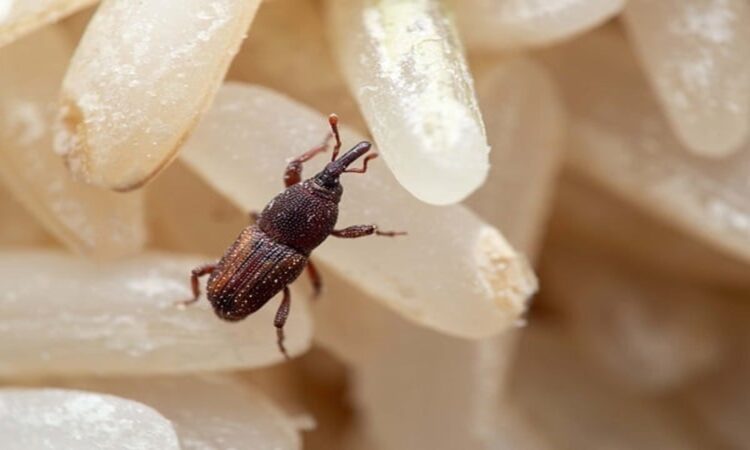
Rice weevil (Sitophilus oryzae) is dark reddish-brown to black, about 1/8 inch, with a distinctive elongated snout. Females bore into individual grain kernels, lay an egg inside, and seal the hole. The larva develops entirely inside the kernel, which means infested rice or wheat can look completely normal until adults emerge.
Other species appearing occasionally include the confused flour beetle, merchant grain beetle, drugstore beetle, and warehouse beetle. Visual identification is usually enough for treatment decisions because the approach is similar across species.
Why the Freeze Trick Actually Works
The single most effective home intervention for newly purchased bulk dry goods is freezing. Cold temperatures kill all stored product pest life stages, including eggs that are not visible at purchase.
The established protocol is 72 hours at 0 degrees Fahrenheit or below, which is standard freezer temperature in most home units. Shorter durations at warmer temperatures produce incomplete kill and do not guarantee eradication. Bulk rice, flour, cornmeal, oatmeal, dried fruit, pet food, birdseed, and nuts treated this way arrive on the pantry shelf already sterilized against incoming eggs.
Heat treatment works as an alternative. 140 degrees Fahrenheit for two hours is sufficient for most species, though oven drying affects texture and is impractical for most home applications. Freezing is the realistic method.
Why Containers Matter More Than People Think
Standard packaging does not exclude pantry pests. Cardboard boxes, waxed paper liners, foil pouches, and most plastic bags can be penetrated by larvae or adult insects either from the outside (as secondary infestation spreads) or from the inside (as hatching adults escape to adjacent packages).
Rigid airtight containers made of glass, heavy-grade plastic, or metal with a positive seal (rubber gasket or screw-top) exclude both escape and entry. Mason jars, Rubbermaid Brilliance containers, OXO Good Grips canisters, and similar products designed with an actual sealed closure work. Flimsy flip-top lids do not.
Transferring bulk goods into sealed containers immediately after the 72-hour freeze accomplishes two things at once: neutralizes any stowaway eggs from the manufacturer and prevents spread from any source still undiscovered on the shelf.
What to Do With an Active Infestation
The treatment sequence for an established pantry pest problem is more involved than the prevention sequence.
Inspect every package on the affected shelf and for two to three shelves in either direction. Larvae, webbing, small adult insects, or fine powder along seams all indicate infestation. Discard anything suspect into a sealed outdoor trash bag rather than an indoor container.
Empty the pantry completely and vacuum the shelves, corners, cracks between shelves and walls, and the underside of every shelf. Larvae often pupate away from the food source, so the cracks and corners matter. Dispose of the vacuum bag or canister contents outside immediately.
Wipe shelves with a household cleaner and dry thoroughly. Residual sprays are rarely necessary and generally inappropriate for food storage areas.
Place pheromone traps for the affected species (Indian meal moth traps are the most widely available) to monitor population decline over the following weeks. Continued catches after three to four weeks indicate an unidentified infested product still present somewhere.
When a Kansas City Pest Control Professional Should Be Involved
Most pantry pest problems resolve with the cleanup and freezing protocol above. Professional intervention makes sense in a few specific situations. Infestations that persist after a thorough cleanout indicate a hidden source, often in a food storage area not yet checked (a rarely used baking cabinet, a storage closet with old pet food, a garage with bulk birdseed). Kansas City pest control companies with stored product experience can conduct pheromone-trap surveys that identify the source faster than trial-and-error cleanup. Commercial situations, including bakeries, restaurants, and food-service kitchens, almost always warrant professional assessment because the economic stakes and regulatory obligations change the picture entirely.
The Short Version
Pantry pests arrive in groceries from the manufacturer, not from dirty kitchens. Freezing bulk dry goods for 72 hours before shelving them stops the cycle before it starts. Airtight containers with real seals prevent spread when something slips through. A thorough cleanout handles most active infestations, and when one persists, a Kansas City pest control provider such as ZipZap Termite & Pest Control can locate the hidden source faster than repeated pantry searches.