
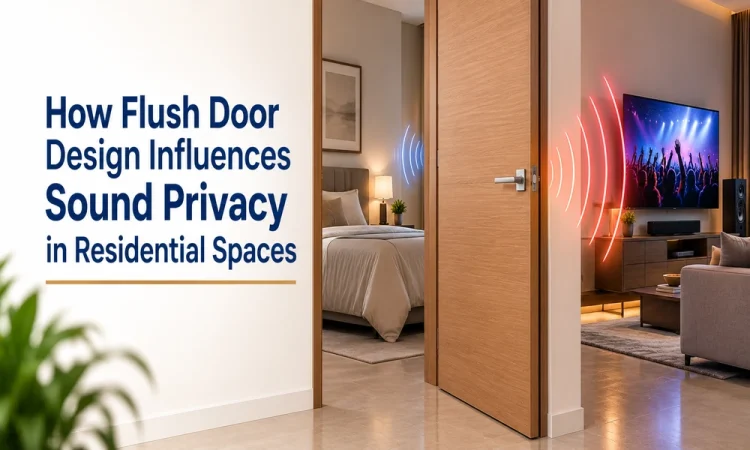
Privacy in terms of sound has a direct relationship to how the inhabitants of a residential unit enjoy their daily lives, from studying in a home office to relaxing in living rooms. Soundproofing is influenced by all sorts of factors, including the type of walls as well as the layout of the interior space.
Flush doors are one of the most sought-after types of doors due to their simplicity in design and wide range of styles available. However, soundproofing will depend on a number of factors,including the material used for construction, weight, and the thickness of the door.
What Is the Role of Design in Sound Transmission?
Though doors serve the purpose of separating rooms, sound can still pass through the door, especially through gaps. The efficiency of the door depends on its construction, which can be described as follows: solid doors are more effective in blocking noise than lightweight hollow ones; solid doors,being heavier than hollow ones, are more soundproof, and door fitting has a major impact on the transmission of sound.
Solid-Core Flush Doors
Solid flush doors are more efficient than hollow-core ones since they do not have an internal cavity. Such flush doors allow less noise to pass and would, therefore, work well for bedrooms and home offices.
Hollow-Core Simple Door Design
Hollow-core flush doors are lightweight, making them good for inexpensive sound blocking. Nevertheless, they are usually not as effective in sound insulation as solid doors.
Does the Thickness of the Door Have an Impact on Sound Insulation?
Thickness is a factor that influences sound insulation but is not the only important factor. Besides thickness, the core type and structure, the density of material, the quality of manufacturing, and core sealing will have an impact on the sound insulation performance. A properly selected core in a thick door will provide better noise insulation than thin lightweight materials used in some doors. Always check technical details from manufacturers when looking for flush doors for bedrooms and living rooms instead of relying on the thickness alone.
Why Is the Gap a Problem?
Even with good design, a door can hardly perform well in terms of sound insulation when there are gaps around the door. Gaps exist in the immediate vicinity of the door hinge. Check where your door should hang without extra space on the sides of the door. Make sure that you stick to the manufacturer’s installation recommendations.
Why Do Two Doors Have Wide Gap Underneath?
When there is a big gap open under the door, sounds can pass from one room to another easily through this opening. Check if the frame of your door is sealed all around the edges. Sticking to proper sealing methods will prevent sound leaks.
How Do Flush Doors Contribute to Sound Insulation of Different Rooms?
Every room presents its own requirements in terms of noise control.
Bedrooms
A flush door installed properly with a solid core can help reduce sounds coming from other rooms or corridors.
Home Offices and Study Rooms
Choose the door with relevant specifications to block unwanted house disturbances during work or study.
Living Rooms
The choice depends on how much sound control is needed for this room and on what scheme will be used for installation.
Children’s Rooms
The installer must ensure that the door is installed in accordance with the demands of safety, supervision, and ventilation.
Does Installation Quality Influence Sound Insulation?
Both design and installation quality influence sound insulation. Poorly aligned hinges result in bigger gaps and lower performance.
Before finishing the installation process, make sure:
- The door is properly aligned with the door frame.
- Sound isolation gaps are as recommended.
- Hinges and hardware are tightly attached.
- Proper seals are used if needed.
- The door operates smoothly.
Do not trim too much off the door to solve fitting problems; otherwise,e the construction and appearance may suffer.
What Is to Be Considered While Looking for Flush Doors?
Look for the following factors when purchasing doors:
- Core type: It should indicate whether the door has a solid or hollow core.
- Thickness/density: Compare technical specifications of the options.
- Acoustic ratings: Look for performance data to be available.
- Frame suitability: The door must fit the frame.
- Use: The door specifications must match the room type where it will be installed.
- Installation requirements: Manufacturer’s fitting and sealing instructions should be followed.
Conclusion
The sound insulation of a flush door is determined by its core, thickness, and density, as well as by how well it fits into the frame. A solid core helps to reduce sound transmission. If the door is not aligned and there are gaps in the door frame, its performance will be low.