
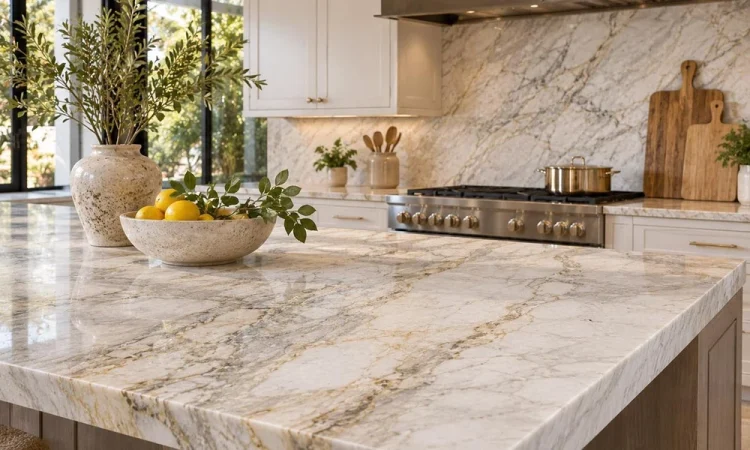
A side-by-side look at hardness, etching, staining, heat, maintenance, and style to help you choose the right natural stone for your kitchen.
You have narrowed your kitchen down to natural stone, and now it is a two-stone race. Both have flowing veins, both feel luxurious, and from across the room, they can look almost identical. Yet when it comes to quartzite vs. marble, the way each one lives in a busy kitchen is very different. This guide compares them point by point, from scratches and etching to sealing and style, so you can choose with confidence. Our Irvine slabyard is the easiest place to see both stones side by side.
Key Takeaways
- Quartzite is much harder than marble and resists scratches and acid etching far better in daily use.
- Marble is softer and etches from acids like lemon and vinegar, developing a patina that some people love.
- Both stones are porous and benefit from sealing, but sealers do not stop marble from etching.
- Marble offers classic Calacatta and Carrara looks, while many quartzites deliver similar veining with more durability.
- Some stones sold as quartzite are actually marble or dolomite, so testing a sample before you buy is essential.
The Quick Answer
In the quartzite vs. marble debate, quartzite is usually the better choice for a hard-working kitchen because it resists scratches and does not etch from common acids. Marble is the right choice if you love its classic beauty and are comfortable with a surface that will gradually show patina from cooking and daily life.
Neither stone is wrong. The best fit depends on how you cook, how you feel about wear marks, and which look speaks to you. Browse our countertop slabs to compare real examples of each.
How They Form and Why It Matters
Quartzite and marble are both metamorphic rocks, meaning they were transformed by heat and pressure underground, but they start from different materials. Quartzite begins as sandstone and becomes a dense, silica-rich stone. Marble begins as limestone and is made mostly of calcite. That difference in minerals explains nearly every performance gap between them.
The Natural Stone Institute groups quartzite with sandstone as silica-based stones, which explains why understanding these origins is the key to choosing between the two. Silica minerals are hard and chemically stable, while calcite is softer and reacts with acids. That is why the two stones can look alike yet behave so differently on a kitchen counter.
Hardness and Scratches
Quartzite is significantly harder than marble. On the Mohs scale, which ranks minerals from 1 (softest) to 10 (hardest), quartzite typically rates around 7, while marble falls around 3 to 5. In practical terms, quartzite resists scratches from everyday kitchen use, while marble can scratch more easily.
The Natural Stone Institute notes that true quartzites cannot be scratched easily with a knife blade and will scratch glass, which shows how wide this hardness gap really is. A dropped pot, a ceramic mug dragged across the surface, or grit under a cutting board, is more likely to leave a mark on marble. Either way, using cutting boards protects your stone and your knives.
Edges and Chipping
Hardness also affects edges. Quartzite holds a crisp edge well, though its hardness can make it a little more brittle on sharp corners. Marble edges can chip or wear more easily over time. A slightly rounded or eased edge profile helps protect either stone in a busy kitchen.
Etching, Staining, and Heat
Etching and staining are two different things, and the difference is central to this comparison. Etching is a dull mark caused by acid reacting with the stone’s surface. Staining occurs when a liquid soaks into the stone’s pores, causing discoloration. Marble can etch and stain, while genuine quartzite resists etching and mainly needs protection from stains.
Etching
Lemon juice, vinegar, wine, tomato sauce, and some cleaners can etch marble within minutes, leaving a dull or lighter spot. Genuine quartzite does not react to these household acids. Light etching on marble can sometimes be polished out, but many marble owners simply accept it as part of the stone’s character.
What Sealers Do and Don’t Do
Sealers soak into the stone and slow how quickly liquids can stain. The Natural Stone Institute is clear that sealers do not protect stone from interactions with acid. So sealing helps both stones resist stains, but it will not stop marble from etching.
Heat
Both stones handle heat well compared with many manufactured surfaces. Still, sudden temperature changes can stress any stone, and very hot pans can affect sealers. Using trivets is a sensible habit with either material.
Sealing slows stains on both stones, but nothing makes marble immune to a squeeze of lemon.
Looks and Style: Where Each Shines
Marble is still the standard for classic elegance. Calacatta marble, with its bright white background and bold veining, and Carrara marble, with its soft gray feathering, have defined luxury kitchens for generations. Honed marble develops a lived-in, European patina that many designers find irresistible.
Quartzite offers its range, from Taj Mahal’s warm cream and gold to crisp white varieties with marble-like veining, along with greens, blues, and dramatic grays. Many quartzites deliver the look people want from marble with more durability. If you are drawn to the trend side of the story, read our post on why designers are choosing quartzite countertops for 2027. Explore both stones in our natural stone collection.
Finish Changes the Story
Finish affects how each stone wears. Polished marble shows etching most clearly, while honed marble hides it better because the whole surface is already matte. Polished quartzite stays bright and glossy for years. Leathered finishes on either stone add texture and disguise fingerprints and water spots.
Maintenance Side by Side
Daily care for both stones is similar: wipe spills promptly, clean with warm water and a pH-neutral stone cleaner, and avoid abrasive scrubbers. The difference is how forgiving each stone is when you miss a spill. Quartzite gives you more time, while marble rewards quicker cleanup.
The Water-Drop Test
To check whether your stone needs resealing, place a few drops of water on the surface and wait several minutes. If the water beads, the sealer is working. If the stone darkens, it is time to reseal. The Natural Stone Institute suggests watching the area around the sink as an early sign, as noted in its quartzite care guide.
How Often to Reseal
Resealing frequency depends on the specific stone, its porosity, and how heavily the kitchen is used. Some dense quartzites rarely need it, while some marbles benefit from more frequent attention. Our care resources offer more tips.
Watch for Mislabeled Stone, Then Decide
Before you decide, make sure you know what you are buying. Some stones sold as quartzite are actually marble or dolomite, a related mineral that is a bit harder than calcite but still etches. Geologist Karin Kirk explains that true quartzite is always hard, so a stone labeled “soft quartzite” is most likely marble.
Two Simple Tests
The glass test: try to scratch a piece of glass with a corner of the stone sample. True quartzite will scratch glass, while marble will not. The etch test: place a drop of lemon juice or vinegar on the sample for several minutes, then wipe it off. If the surface dulls, the stone contains calcite or dolomite.
Who Should Choose Which
Choose quartzite if you cook often, have kids, entertain frequently, or want a marble look with less worry. Choose marble if you love its classic beauty, cook more lightly, or embrace a surface that shows the story of your kitchen over time. Some homeowners split the difference, using quartzite on the busy island and marble on a baking station or bar.
Choose quartzite for peace of mind, and marble if you love every mark it gathers.
Material availability, pricing, and lead times vary by project and slab selection. They are confirmed in our showroom or with a formal quote.
Making Your Choice
When weighing quartzite vs. marble, start with how your kitchen really works. Quartzite offers hardness and etch resistance for busy households, while marble offers timeless beauty with a patina that grows over time. Test your samples, see full slabs in person, and pick the stone that fits both your style and your routine.
Ready to see these materials in person? The team at Trendy Surfaces has been helping Orange County homeowners, designers, and contractors find the right tile, stone, and flooring for their projects. Our Irvine slabyard lets you compare quartzite and marble slabs side by side in natural light.
Visit the Irvine Slabyard & Showroom at 17912 Cowan, Unit C, Irvine, CA 92614, or call (714) 284-0118. Or stop by the Laguna Niguel Design Center at 23811 Aliso Creek Road, Ste 176, Laguna Niguel, CA 92677, or call (949) 446-8121.
Frequently Asked Questions
Is quartzite better than marble for kitchens?
For most busy kitchens, yes. Quartzite is harder and resists scratches and acid etching better than marble. Marble remains a beautiful choice for homeowners who accept, or even enjoy, the patina it develops over time.
Does quartzite etch like marble?
Genuine quartzite does not etch from common household acids, such as lemon juice or vinegar. If a stone sold as quartzite etches, it likely contains calcite or dolomite and may actually be a marble or dolomitic marble.
Do both quartzite and marble need sealing?
Yes, both are natural stones with pores, so an impregnating sealer helps resist stains. Sealing does not prevent marble from etching. A simple water-drop test tells you when either stone needs resealing.
Which costs more, quartzite or marble?
It depends on the specific stone. Both range from moderate to very high based on rarity, slab size, and thickness. Quartzite’s hardness can also make fabrication more involved. Pricing is confirmed by a quote for your specific slab and layout.
How can I tell if a slab is real quartzite?
Ask for a sample and try two tests. True quartzite scratches glass, while marble does not. A drop of lemon juice or vinegar left for a few minutes will dull marble or dolomite but not genuine quartzite.