

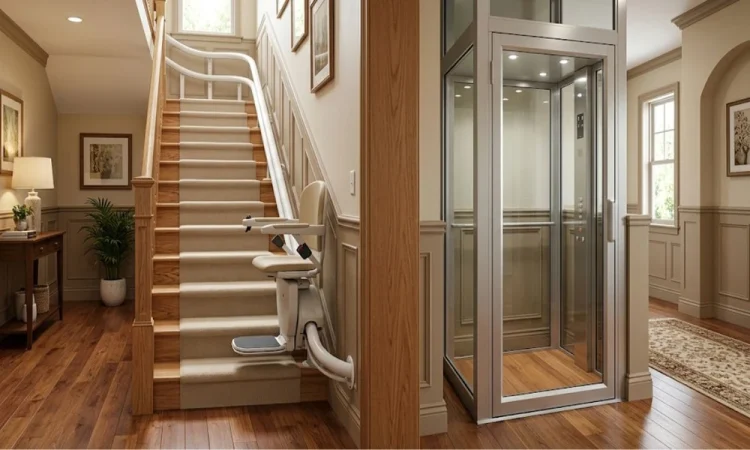
Deciding between a stairlift vs home elevator Malaysia homeowners are weighing up often comes down to a mix of budget, urgency, and long-term household needs. Both solve mobility challenges between floors, but they differ significantly in installation, cost, comfort, and suitability for different situations. Understanding these differences helps avoid choosing based on price alone, when the better fit might actually depend on entirely different factors.
What Is the Core Difference Between a Stairlift and a Home Elevator?
A stairlift is a seated chair that travels along a rail fitted directly to an existing staircase, moving one person at a time along the exact path of the stairs. A home elevator is a fully enclosed cabin that travels vertically through a shaft or self-supporting structure, independent of the staircase itself, and can typically accommodate more than one person or additional items.
This fundamental difference in mechanism shapes nearly every other point of comparison between the two.
Installation Differences
Stairlifts require minimal structural work, since the rail mounts directly onto the existing staircase. Installation is typically completed within a day or two, making it one of the fastest mobility solutions available.
Home elevators require more significant planning, whether through a self-supporting structure or a built shaft, and installation timelines range from days to several weeks depending on the model and any structural work involved.
Cost Differences
Stairlifts are generally the more affordable option, reflecting their simpler mechanism and faster installation. Home elevators represent a larger investment, but offer considerably more functionality, including the ability to move between multiple floors, carry more than one person, and transport larger items alongside passengers.
Neither option should be evaluated purely on upfront cost. A stairlift in Malaysia solves single-staircase mobility effectively but doesn’t address broader household movement, while a home elevator’s higher initial cost reflects a genuinely different scope of capability.
Comfort and Ride Experience
A stairlift ride is functional and safe but relatively basic, with the user seated throughout the journey along the exact path of the staircase. A home elevator offers a more spacious, enclosed ride experience, often standing rather than seated, with considerably more room to move, carry items, or accompany another person comfortably.
For households prioritising a more premium daily experience, particularly if the lift will be used frequently by multiple family members, a home elevator’s comfort advantage becomes more meaningful over time.
Stairlift vs Home Elevator: Direct Comparison
| Factor | Stairlift | Home Elevator |
| Installation time | Days | Days to several weeks |
| Structural changes | Minimal | Moderate, depending on model |
| Typical cost | Lower | Higher |
| Capacity | One person | Multiple people or items |
| Best suited for | Single staircase mobility | Whole-household, multi-floor use |
| Long-term flexibility | Limited to existing staircase | Adaptable to broader household needs |
When Does a Stairlift Make More Sense?
- The mobility need is specific to one staircase, rather than whole-home movement
- Budget constraints make a full elevator impractical in the near term
- The need is relatively urgent, and a fast installation timeline matters
- The household doesn’t anticipate needing to transport larger items or multiple people regularly between floors
When Does a Home Elevator Make More Sense?
- Multiple household members, including children or additional elderly residents, need regular multi-floor movement
- Wheelchair access with an accompanying caregiver is a consideration
- The household regularly needs to transport larger items, such as groceries or luggage, between floors
- Long-term planning favours a more comprehensive, adaptable mobility solution rather than an interim fix
Can Both Be Installed in the Same Home?
In some cases, yes. A household might install a stairlift for one staircase serving a specific need, while planning for a home elevator as a longer-term addition elsewhere in the property. This isn’t the right approach for every home, but it’s worth knowing that the two solutions aren’t mutually exclusive if genuine need exists for both.
Elite Elevators’ Options Across Both Categories
For households leaning toward a home elevator, Elite Elevators’ X200 offers a compact, cost-conscious entry point with a 100mm pit requirement and 400kg capacity, while the X400 with no machine room requirement syands on a more premium, spacious experience. For stairlift needs specifically, the E50 stairlift is engineered to fit straight, curved, and even narrow staircases (down to 610mm), with seven layered safety features including a seatbelt and obstruction sensors, offering a genuinely comparable safety standard to home elevator options despite its simpler mechanism.
Common Mistakes When Choosing Between the Two
Choosing based on cost alone, without considering long-term needs: A cheaper stairlift may not address broader household mobility needs that emerge later.
Assuming a home elevator is always the “better” option: For single-staircase needs, a stairlift can be a genuinely effective and appropriately scaled solution.
Not considering future mobility changes: A stairlift addresses today’s needs well but offers less flexibility if household requirements broaden over time.
Overlooking installation timeline needs: If the mobility need is urgent, a stairlift’s faster installation may outweigh other considerations.
Conclusion
Choosing between a stairlift vs home elevator ultimately depends on the specific mobility need, budget, timeline, and long-term household plans, rather than one option being universally superior to the other. A stairlift offers a fast, cost-effective solution for single-staircase mobility, while a home elevator provides broader, more comfortable, and more adaptable functionality for whole-household use. Taking the time to honestly assess current and future needs will lead to a more satisfying choice than defaulting to whichever option seems simplest at first glance.
Frequently Asked Questions
1. Is a stairlift cheaper than a home elevator?
Yes, generally. Stairlifts require less structural work and simpler mechanisms, making them the more affordable option upfront.
2. Which is better for elderly users, a stairlift or a home elevator?
It depends on the specific need. A stairlift suits single-staircase mobility well, while a home elevator better serves broader, whole-household movement needs.
3. How long does it take to install a stairlift versus a home elevator?
Stairlifts typically install within a day or two, while home elevators can take anywhere from several days to a few weeks depending on the model and site requirements.
4. Can a stairlift and home elevator be installed in the same house?
Yes, in some cases, particularly if different areas of the home have distinct mobility needs.
5. Which option offers more long-term flexibility?
A home elevator generally offers more flexibility, accommodating multiple users, items, and potential future mobility changes more comprehensively than a stairlift.
6. Is a home elevator necessary if a stairlift already solves the mobility issue?
Not necessarily. If the need is limited to a single staircase and doesn’t extend to broader household movement, a stairlift can be a fully appropriate long-term solution.